Fe-6.5wt%Si high silicon steel is recognized as an optimal magnetic material due to its low iron loss, near-zero magnetostriction, and high saturation magnetization, offering significant advantages in energy savings, weight reduction, and miniaturization of electrical equipment. However, its high brittleness presents substantial challenges for conventional manufacturing processes, and large-scale production remains a global challenge. This paper reports the successful preparation of Fe-6.5wt%Si high silicon steel using the Double Glow Plasma Surface Metallurgy Technology, also referred to as the Xu-Tec process. In this method, a dual-electrode glow discharge configuration is employed within a vacuum vessel, where silicon is sputtered from a pure source cathode and deposited onto a low-silicon steel workpiece cathode, followed by inward diffusion under argon ion bombardment at elevated temperatures. Through systematic optimization of process parameters—including source voltage, workpiece voltage, argon pressure, treatment temperature, and holding time—both homogeneous and gradient high silicon steels were successfully fabricated. Microstructural characterization and compositional analysis revealed that the homogeneous Xu-Tec high silicon steel achieved an average cross-sectional silicon content exceeding 6.5 wt%, while the gradient variant exhibited controlled silicon distribution from the surface to the core. Notably, the thickness of the Xu-Tec processed samples was twice that of the Japanese JNEX 900 and JNHF 600 products, indicating superior diffusion efficiency. The Xu-Tec process is simple, environmentally friendly, and free from corrosion and pollution, offering a promising new route for the large-scale production of high silicon steel. This study provides a foundational basis for future application research and industrialization efforts.
This is an Open Access article, distributed under the terms of the Creative Commons Attribution 4.0 International License (http://creativecommons.org/licenses/by/4.0/), which permits unrestricted use, distribution and reproduction in any medium or format, provided the original work is properly cited.
Double Glow Plasma Surface Metallurgy, Fe-6.5wt%Si High Silicon Steel, Homogeneous High Silicon Steel,
Gradient High Silicon Steel, Xu-Tec Process
1. Important Significance of Fe-6.5%Si High Silicon Steel
In 1964, D. Brown
[1]
D. Brown, C. Holt, J. E. Thompson. Technical assessment of 6½% (wt.) silicon iron for possible application in power transformers. Proceedings of the Institution of Electrical Engineers 1964; 111(11): 1933-1936.
discovered that high silicon steel sheets with a silicon content of 6.5wt% Si exhibited excellent magnetic properties, such as low iron loss, near zero magnetostriction, and high saturation magnetization.
High silicon steel generally refers to Si-Fe alloys with a silicon content of 4.5 to 6.7 wt%. High silicon steel with a silicon content of 6.5% is a premium product among high silicon steels. High silicon steel can significantly save energy, reduce material consumption, and enable many electrical appliances to achieve high efficiency and miniaturization.
[2]
J. S. Shin, J. S. Bae, H. J. Kim, H. M. Lee, T. D. Lee, E. J. Lavernia, Z. H. Lee. Ordering–disordering phenomena and micro-hardness characteristics of B2 phase in Fe–(5–6.5%)Si alloys. Materials Science and Engineering: A 2005; 407(1): 282-290.
For example, in a transformer, an increase of 1.5% in energy efficiency implies a direct saving of 240×109 kW∙h, which is equivalent to $12 billion/yr for electricity price of $0.05/kW∙h.
[4]
B. D. Cullity, C. D. Graham, Introduction to Magnetic Materials, John Wiley & Sons, 2008.
[4]
Another example is that JFE Company in Japan uses high silicon steel containing 6.5wt% silicon instead of ordinary silicon steel containing 3 wt% silicon, reducing the weight of the iron core of an 8 kHz welding machine from 7.5 kg to 3 kg.
[5]
H. Haiji, K. Okada, T. Hiratani, M. Abe, M. Ninomiya. Magnetic properties and workability of 6.5% Si steel sheet. Journal of Magnetism and Magnetic Materials 1996; 160: 109-114.
However, high silicon steel with high silicon content has high hardness and brittleness, making it difficult to prepare through ordinary rolling methods. In order to avoid its brittleness problem, people use technologies such as PVD,
[6]
X. D. He, X. Li, Y. Sun. Microstructure and magnetic properties of high silicon electrical steel produced by electron beam physical vapor deposition. Journal of Magnetism and Magnetic Materials 2008; 320(3): 217-221.
T. Yamaji, M. Abe, Y. Takada, K. Okada, T. Hiratani. Magnetic properties and workability of 6.5% silicon steel sheet manufactured in continuous CVD siliconizing line. Journal of Magnetism and Magnetic Materials 1994; 133(1): 187-189.
Y. F. Liang, S. Wang, H. Li, Y. M. Jiang, F. Ye, J. P. Lin. Fabrication of Fe-6.5wt%Si Ribbons by Melt Spinning Method on Large Scale. Advances in Materials Science and Engineering 2015; 2015 (1): 296197.
C.-S. Li, C.-L. Yang, G.-J. Cai, Q.-W. Wang. Ordered phases and microhardness of Fe–6.5%Si steel sheet after hot rolling and annealing. Materials Science and Engineering: A 2016; 650: 84-92.
R. Li, Q. Shen, L. Zhang, T. Zhang. Magnetic properties of high silicon iron sheet fabricated by direct powder rolling. Journal of Magnetism and Magnetic Materials 2004; 281(2): 135-139.
T. Ros-Yañez, Y. Houbaert, V. Gómez Rodrı́guez. High-silicon steel produced by hot dipping and diffusion annealing. Journal of Applied Physics 2002; 91(10): 7857-7859.
etc to study and produce high silicon steel without success.
2. Production Lines for High Silicon Steel Manufactured by NKK and JFE in Japan
In 1988, Japanese NKK Steel Company's Yoshikazu Takada and Masahiro Abe successfully produced high silicon steel containing 6.5% silicon in the laboratory using the SiCl4-CVD method.
[7]
T. Yamaji, M. Abe, Y. Takada, K. Okada, T. Hiratani. Magnetic properties and workability of 6.5% silicon steel sheet manufactured in continuous CVD siliconizing line. Journal of Magnetism and Magnetic Materials 1994; 133(1): 187-189.
In 1993, NKK built a high silicon steel production line capable of manufacturing thicknesses of 0.1-0.5mm and widths of 400mm, with a monthly output of up to 100 tons.
[7]
T. Yamaji, M. Abe, Y. Takada, K. Okada, T. Hiratani. Magnetic properties and workability of 6.5% silicon steel sheet manufactured in continuous CVD siliconizing line. Journal of Magnetism and Magnetic Materials 1994; 133(1): 187-189.
In 1995, Japan successfully developed gradient high silicon steel JNHF Core based on the research of homogeneous high silicon steel JNEX Core.
However, there are some issues with using SiCl4-CVD technology to manufacture high silicon steel, including:
(1) SiCl4 corrodes silicon steel sheets, causing corrosion pits on their surfaces, and the subsequent leveling process is cumbersome. The success yield of high silicon steel is relatively low.
(2) The process is complex, pollutes the environment, causes severe corrosion, has high costs, and is expensive.
Due to the above reasons, the scale of production of high silicon steel with 6.5% silicon content by JFE in Japan is greatly limited. Its sales price in the Chinese market is about 20 times of that of ordinary silicon steel.
In 1930, Dr. Berghaus of Germany invented plasma nitriding and obtained German patents.
[12]
B. Berghaus, Germany Patent 668639, 1932.
[12]
Based on the research of plasma nitriding technology for many years, Zhong Xu invented the “Double Glow Plasma Surface Metallurgy Technology” (also called as Xu-Tec process) in 1980. The technology can be employed for all of the chemical elements in the periodic table, including solid metal elements and gaseous nonmetallic elements to realize surface alloying on the surface of metallic material. The Springer Press published a monograph with the title “PLASMA SURFACE METALLURGY with Double Glow Discharge Technology - Xu-Tec Process” detailing the “Double Glow Plasma Surface Metallurgy/Alloying Technology” in 2017.
[13]
Z. Xu, J. Huang, H. Wu, Z. Xu, X. Liu, N. Lin, D. Wei, P. Zhang. A modern-day alchemy: Double glow plasma surface metallurgy technology. AIP Advances 2022; 12(3): 030702.
X. Zhong, H. Jun, X. Zaifeng, L. Xiaoping, W. Hongyan. Plasma Surface Metallurgy of Materials Based on Double Glow Discharge Phenomenon. American Journal of Physics and Applications 2021; 9(4): 70-87.
Z. Xu, F. F. Xiong, Plasma Surface Metallurgy: With Double Glow Discharge Technology—Xu-Tec Process, Springer Singapore, Singapore, 2017.
[13-15]
.
4. Experimental Setup and Process Parameters
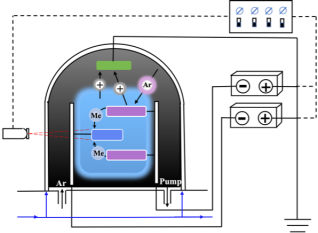
Figure 1 displays the Schematic Diagram of Xu-Tec siliconizing setup. Three electrodes are set in a vacuum vessel: anode(green), work-piece cathode(blue)and two source cathode(purple)which are made by silicon materials. Two adjustable voltage DC power supplies (0–1200 V) are set between the anode and the work-piece and between the anode and the two source cathodes, respectively. Both the work-piece and the source cathodes are in negative potential. After the chamber is vacuumed, a certain amount of argon gas is filled. Then, with the increase in voltages of the power supplies, glow discharges will be generated between the anode and the work-piece and between the anode and the source cathodes at the same time. The positive ions of argon generated by glow discharge bombard the source cathode, causing the silicon to be sputtered and subsequently transported and adsorbed onto the surface of the work-piece. At the same time, the positive ions of argon bombard the work-piece cathode, heating it up to high temperature and causing the silicon adsorbed onto the surface of the work-piece to diffuse inward, forming a layer rich in silicon.
[16]
Y. Qiu, L. Yu, J. Zhou, H. Zhu, D. Yang, L. Yu, R. Chen, C. Zhang, R. Ni, Q. Li, H. Wu. Study of plasma characteristics of hollow cathode in glow discharge. Journal of Physics D: Applied Physics 2023; 56(48): 485201.
L. Yu, Y. Wen, J. Zhou, Y. Qiu, D. Yang, H. Dai, H. Zhu, Z. Hu, G. Liu, A. M. Khan, H. Wu. Study on the Multi-Physical Field Simulation of the Double-Glow Plasma Alloying Process Parameters. Coatings 2024; 14(9): 1175.
X. Tao, Z. Fan, Q. Li, Y. Wen, Z. Hu, G. Liu, A. M. Khan, H. Wu. Study on the synergistic diffusion mechanism of double glow plasma alloying and its impact on the magnetic properties of non-oriented silicon steel. Journal of Magnetism and Magnetic Materials 2025; 630: 173437.
Figure 1. Schematic Diagram of Xu-Tec siliconizing setup unit.
For this purpose, the experimental work-piece is made of Fe-3.6wt%Si silicon steel sheet with 0.20 mm thickness and size of 70 mm×70 mm. A pure silicon plate (size 100 mm×80 mm×6 mm) was used as the sputtering target, called source electrode, and then Silicon elements were diffused into the 3.6wt% silicon steel, called work-piece electrode, by Xu-Tec process. Field emission scanning electron microscopy and energy spectrometer were used to characterize the surface and cross-sectional morphology of the coating, the corresponding elemental composition was also detected. The high silicon steels produced by JFE company in Japan, JNEX 900 and JNHF 600 were also detected as a comparison sample.
Experimental materials and main process parameters:
1) Work-piece material: Silicon steel sheet containing 3.6wt% silicon, with dimensions of 70 mm×70 mm×0.2 mm;
2) Source material: monocrystalline silicon with dimensions of 100 mm×80 mm×6 mm;
3) Argon gas pressure: 15-35 Pa;
4) Source voltage: 900-1100 V;
5) Working-piece voltage: 300-600 V;
6) The distance between the working-piece and the source: 16-35 mm;
7) Operation alloying temperature: 1000-1200°C;
8) Holding time: 1-6 h.
5. Experimental Results
This experiment aimed to form the silicon content distribution in the cross-sections of 0.1mm-thick JNEX900 and JNHF600 high-silicon steel products from Japan. But due to the limitation of raw material supply, we could only use 0.2mm silicon steel sheets with a silicon content of 3.6% as the experimental materials. After more than a year and over 200 experiments, the following research results were obtained.
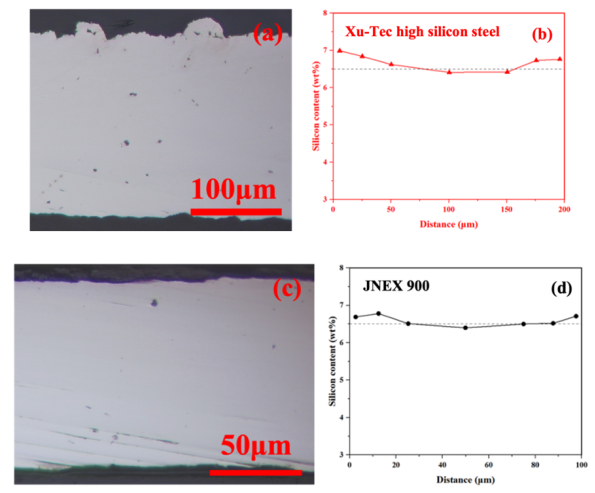
Figure 2 shows the cross-sectional microstructure and silicon content of Fe-6.5wt%Si high silicon steel. Figure 2a and 2b were the cross-sectional morphology and the silicon content distribution curve of Xu-Tec high silicon steel, while Figure 2c and 2d were those of JNEX 900. It is obvious that both Xu-Tec high silicon steel and JNEX 900 have an average silicon content in their cross-sections that is more than 6.5 wt%. The surface silicon content of Xu-Tec high silicon steel is 6.99 wt% on one surface and 6.76 wt% on the other, with a central content of 6.41 wt%. In the above photos of the microstructure of high-silicon steel section, Japanese JFE high-silicon steel is a high-silicon steel sample sold in the market, but Xu-Tec high-silicon steel is a high-silicon steel sample after siliconizing treatment, and the sediment on its surface can be eliminated in the future surface purification treatment. It should be emphasized that, the thickness of Xu-Tec high silicon steel is twice of JNEX 900 which means that Xu-Tec has much better element diffusion efficiency.
Figure 2. Microstructure and silicon distribution of cross-section for Xu-Tec high silicon steel (a and b) and JNEX 900 (e and d).
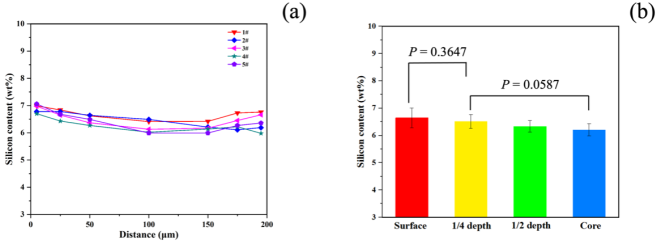
According to the above experimental results, 5 times repeated experiments were carried out, and their silicon content in cross-section were shown in Figure 3. The results show that there is good repeatability. Figure 3b present the average silicon content of Xu-Tec high silicon steels in cross-section. There is no significant difference in the average silicon content among 1/4 depth, 1/2 depth and the core, meaning that the silicon content in Xu-Tec high silicon steel is homogeneous. There is also no significant difference in the average silicon content between the surface and 1/4 depth, according to one-way analysis of variance (ANOVA) performed to determine the statistical significance of the data. Differences were considered significant at P < 0.05, and highly significant at P < 0.01.
Figure 3. Silicon content of Xu-Tec high silicon steels in cross-section.
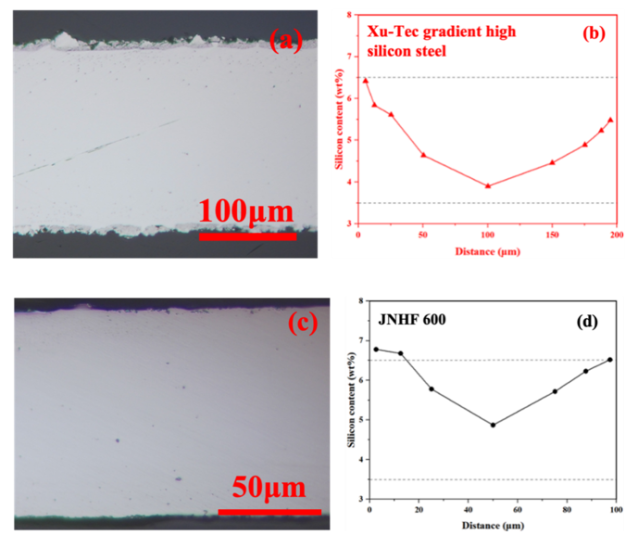
Figure 4 shows microstructure and silicon distribution of Fe-6.5wt%Si gradient high silicon steel. The cross-sectional morphology and the silicon content distribution curve of Xu-Tec gradient high silicon steel were shown in Figure 4a and4b, while those of JNHF 600 were illustrated in Figure 4c and 4d. A high silicon steel with gradient silicon content in cross-section was also fabricated by Xu-Tec process. The surface silicon content of Xu-Tec gradient high silicon steel is 6.42 wt% on one surface and 5.48 wt% on the other, with a central content of 3.90 wt%. It also should be emphasized that, the thickness of Xu-Tec high silicon steel is twice of JNHF 600.
The Xu-Tec process itself is a surface alloying technology that relies on diffusion to form gradient distribution of alloying elements of surface alloy. Therefore, using Xu-Tec to make gradient high silicon steel is not only simple and easy, but also can form a variety of gradient high silicon steel.
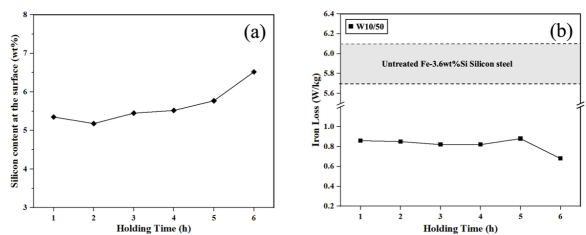
The influence of alloying time on silicon content and iron loss were studied, and their relationship was illustrated in Figure 5. The experimental results show that the homogeneous high silicon steel containing 6.5% silicon can be obtained by siliconizing with the holding time of 6 hours, and its iron loss at 50Hz is 0.68. The all rest high silicon steel obtained from 1 to 5 hour holding time is gradient high silicon steel with different silicon content distribution, and they all have 50 Hz iron loss of less than 1.0 W/kg, which is much lower than that of the untreated 3.6 wt% silicon steel. The iron loss of raw material containing 3.6% silicon steel at 50Hz is 5.7-6.1.
Figure 5. The curves of holding time vs. silicon content and iron loss.
The above experimental results reveal an important phenomenon for us: the silicon content on the most outer surface of the surface of high silicon steel has a very important impact on iron loss, which also shows the importance of skin effect under the action of AC electromagnetic field. It can be predicted that with the continuous increase of electromagnetic field frequency, the skin effect will become more obvious. Therefore, in the future large-scale production of high silicon steel, the skin effect can be fully used to shorten the holding time, reduce brittleness and improve the production efficiency.
The Xu-Tec siliconizing is relatively simple, easy to implement, without any corrosion and pollution, and may provide a new way to achieve large-scale production of high-silicon steel in the world.
6. Conclusion and Prospect
1) Research results show that the Xu-Tec process is feasible to prepare high silicon steel.
2) Feasibility of using mono-crystalline silicon as a sputtering target to provide silicon element.
3) It is proved that low silicon steel is feasible to produce high silicon steel as raw material of high silicon steel.
4) It is proved that the low silicon steel with thickness of 200 μm can directly form uniform high silicon steel.
5) Except for uniform high silicon steel, the rest belong to the range of gradient high silicon steel. It is easy to prepare gradient high silicon steel.
6) Xu-Tec siliconizing does not have high temperature corrosion and environmental pollution in the production process. Under the condition of ion bombardment, the diffusion rate of silicon is fast.
7) Experimental study provides an experimental basis for the application research and industrialization of high silicon steel in the future.
8) Xu-Tec technology provides a new way for the development and scale industrialization of high silicon steel, and its prospect is very bright.
Our research team originally planned to realize the industrialization of high silicon steel through the following four stages: Basic feasibility study - Application Study - Pilot stage - Large-scale production stage. We have completed the first stage of experimental research. At the beginning of 2024, the experimental research was forced to stop due to the interruption of research funds. We have been striving for research funds in many aspects for more than a year without success, so we decided to publish this article, hoping to arouse the attention and interest of academia and industry, and strive to realize the large-scale production of high silicon steel as soon as possible for the benefit of mankind.
Abbreviations
PVD
Physical Vapor Deposition
CVD
Chemical Vapor Deposition
AC
Alternating Current
Acknowledgments
The authors are very grateful to young entrepreneurs Mr. Bin Zhang for investing our research on high silicon steel.
Author Contributions
Zhong Xu: Conceptualization, Methodology, Writing – original draft, Supervision
Jun Huang: Visualization, Writing – review & editing, Formal analysis
Hongyan Wu: Methodology, Investigation, Resources
Rui Chen: Investigation, Data Curation
Chengyuan Zhang: Investigation, Data Curation, Visualization
Zaifeng Xu: Data Curation, Visualization
Weixin Zhang: Investigation, Data Curation
Lei Hu: Methodology, Investigation, Resources
Bin Zhang: Writing – review & editing
Conflicts of Interest
The authors conflict that they have no known competing financial interests or personal relationships that could have appeared to influence the work reported in this paper.
References
[1]
D. Brown, C. Holt, J. E. Thompson. Technical assessment of 6½% (wt.) silicon iron for possible application in power transformers. Proceedings of the Institution of Electrical Engineers 1964; 111(11): 1933-1936.
J. S. Shin, J. S. Bae, H. J. Kim, H. M. Lee, T. D. Lee, E. J. Lavernia, Z. H. Lee. Ordering–disordering phenomena and micro-hardness characteristics of B2 phase in Fe–(5–6.5%)Si alloys. Materials Science and Engineering: A 2005; 407(1): 282-290.
B. D. Cullity, C. D. Graham, Introduction to Magnetic Materials, John Wiley & Sons, 2008.
[5]
H. Haiji, K. Okada, T. Hiratani, M. Abe, M. Ninomiya. Magnetic properties and workability of 6.5% Si steel sheet. Journal of Magnetism and Magnetic Materials 1996; 160: 109-114.
X. D. He, X. Li, Y. Sun. Microstructure and magnetic properties of high silicon electrical steel produced by electron beam physical vapor deposition. Journal of Magnetism and Magnetic Materials 2008; 320(3): 217-221.
T. Yamaji, M. Abe, Y. Takada, K. Okada, T. Hiratani. Magnetic properties and workability of 6.5% silicon steel sheet manufactured in continuous CVD siliconizing line. Journal of Magnetism and Magnetic Materials 1994; 133(1): 187-189.
Y. F. Liang, S. Wang, H. Li, Y. M. Jiang, F. Ye, J. P. Lin. Fabrication of Fe-6.5wt%Si Ribbons by Melt Spinning Method on Large Scale. Advances in Materials Science and Engineering 2015; 2015 (1): 296197.
C.-S. Li, C.-L. Yang, G.-J. Cai, Q.-W. Wang. Ordered phases and microhardness of Fe–6.5%Si steel sheet after hot rolling and annealing. Materials Science and Engineering: A 2016; 650: 84-92.
R. Li, Q. Shen, L. Zhang, T. Zhang. Magnetic properties of high silicon iron sheet fabricated by direct powder rolling. Journal of Magnetism and Magnetic Materials 2004; 281(2): 135-139.
T. Ros-Yañez, Y. Houbaert, V. Gómez Rodrı́guez. High-silicon steel produced by hot dipping and diffusion annealing. Journal of Applied Physics 2002; 91(10): 7857-7859.
Z. Xu, J. Huang, H. Wu, Z. Xu, X. Liu, N. Lin, D. Wei, P. Zhang. A modern-day alchemy: Double glow plasma surface metallurgy technology. AIP Advances 2022; 12(3): 030702.
X. Zhong, H. Jun, X. Zaifeng, L. Xiaoping, W. Hongyan. Plasma Surface Metallurgy of Materials Based on Double Glow Discharge Phenomenon. American Journal of Physics and Applications 2021; 9(4): 70-87.
Z. Xu, F. F. Xiong, Plasma Surface Metallurgy: With Double Glow Discharge Technology—Xu-Tec Process, Springer Singapore, Singapore, 2017.
[16]
Y. Qiu, L. Yu, J. Zhou, H. Zhu, D. Yang, L. Yu, R. Chen, C. Zhang, R. Ni, Q. Li, H. Wu. Study of plasma characteristics of hollow cathode in glow discharge. Journal of Physics D: Applied Physics 2023; 56(48): 485201.
L. Yu, Y. Wen, J. Zhou, Y. Qiu, D. Yang, H. Dai, H. Zhu, Z. Hu, G. Liu, A. M. Khan, H. Wu. Study on the Multi-Physical Field Simulation of the Double-Glow Plasma Alloying Process Parameters. Coatings 2024; 14(9): 1175.
X. Tao, Z. Fan, Q. Li, Y. Wen, Z. Hu, G. Liu, A. M. Khan, H. Wu. Study on the synergistic diffusion mechanism of double glow plasma alloying and its impact on the magnetic properties of non-oriented silicon steel. Journal of Magnetism and Magnetic Materials 2025; 630: 173437.
Xu, Z., Huang, J., Wu, H., Chen, R., Zhang, C., et al. (2026). Formation of Fe-6.5wt%Si High Silicon Steel by Double Glow Plasma Surface Metallurgy Technology. American Journal of Physics and Applications, 14(2), 18-24. https://doi.org/10.11648/j.ajpa.20261402.11
@article{10.11648/j.ajpa.20261402.11,
  author = {Zhong Xu and Jun Huang and Hongyan Wu and Rui Chen and Chengyuan Zhang and Zaifeng Xu and Weixin Zhang and Lei Hu and Bin Zhang},
  title = {Formation of Fe-6.5wt%Si High Silicon Steel by Double Glow Plasma Surface Metallurgy Technology},
  journal = {American Journal of Physics and Applications},
  volume = {14},
  number = {2},
  pages = {18-24},
  doi = {10.11648/j.ajpa.20261402.11},
  url = {https://doi.org/10.11648/j.ajpa.20261402.11},
  eprint = {https://article.sciencepublishinggroup.com/pdf/10.11648.j.ajpa.20261402.11},
  abstract = {Fe-6.5wt%Si high silicon steel is recognized as an optimal magnetic material due to its low iron loss, near-zero magnetostriction, and high saturation magnetization, offering significant advantages in energy savings, weight reduction, and miniaturization of electrical equipment. However, its high brittleness presents substantial challenges for conventional manufacturing processes, and large-scale production remains a global challenge. This paper reports the successful preparation of Fe-6.5wt%Si high silicon steel using the Double Glow Plasma Surface Metallurgy Technology, also referred to as the Xu-Tec process. In this method, a dual-electrode glow discharge configuration is employed within a vacuum vessel, where silicon is sputtered from a pure source cathode and deposited onto a low-silicon steel workpiece cathode, followed by inward diffusion under argon ion bombardment at elevated temperatures. Through systematic optimization of process parameters—including source voltage, workpiece voltage, argon pressure, treatment temperature, and holding time—both homogeneous and gradient high silicon steels were successfully fabricated. Microstructural characterization and compositional analysis revealed that the homogeneous Xu-Tec high silicon steel achieved an average cross-sectional silicon content exceeding 6.5 wt%, while the gradient variant exhibited controlled silicon distribution from the surface to the core. Notably, the thickness of the Xu-Tec processed samples was twice that of the Japanese JNEX 900 and JNHF 600 products, indicating superior diffusion efficiency. The Xu-Tec process is simple, environmentally friendly, and free from corrosion and pollution, offering a promising new route for the large-scale production of high silicon steel. This study provides a foundational basis for future application research and industrialization efforts.},
 year = {2026}
}
TY  - JOUR
T1  - Formation of Fe-6.5wt%Si High Silicon Steel by Double Glow Plasma Surface Metallurgy Technology
AU  - Zhong Xu
AU  - Jun Huang
AU  - Hongyan Wu
AU  - Rui Chen
AU  - Chengyuan Zhang
AU  - Zaifeng Xu
AU  - Weixin Zhang
AU  - Lei Hu
AU  - Bin Zhang
Y1  - 2026/04/14
PY  - 2026
N1  - https://doi.org/10.11648/j.ajpa.20261402.11
DO  - 10.11648/j.ajpa.20261402.11
T2  - American Journal of Physics and Applications
JF  - American Journal of Physics and Applications
JO  - American Journal of Physics and Applications
SP  - 18
EP  - 24
PB  - Science Publishing Group
SN  - 2330-4308
UR  - https://doi.org/10.11648/j.ajpa.20261402.11
AB  - Fe-6.5wt%Si high silicon steel is recognized as an optimal magnetic material due to its low iron loss, near-zero magnetostriction, and high saturation magnetization, offering significant advantages in energy savings, weight reduction, and miniaturization of electrical equipment. However, its high brittleness presents substantial challenges for conventional manufacturing processes, and large-scale production remains a global challenge. This paper reports the successful preparation of Fe-6.5wt%Si high silicon steel using the Double Glow Plasma Surface Metallurgy Technology, also referred to as the Xu-Tec process. In this method, a dual-electrode glow discharge configuration is employed within a vacuum vessel, where silicon is sputtered from a pure source cathode and deposited onto a low-silicon steel workpiece cathode, followed by inward diffusion under argon ion bombardment at elevated temperatures. Through systematic optimization of process parameters—including source voltage, workpiece voltage, argon pressure, treatment temperature, and holding time—both homogeneous and gradient high silicon steels were successfully fabricated. Microstructural characterization and compositional analysis revealed that the homogeneous Xu-Tec high silicon steel achieved an average cross-sectional silicon content exceeding 6.5 wt%, while the gradient variant exhibited controlled silicon distribution from the surface to the core. Notably, the thickness of the Xu-Tec processed samples was twice that of the Japanese JNEX 900 and JNHF 600 products, indicating superior diffusion efficiency. The Xu-Tec process is simple, environmentally friendly, and free from corrosion and pollution, offering a promising new route for the large-scale production of high silicon steel. This study provides a foundational basis for future application research and industrialization efforts.
VL  - 14
IS  - 2
ER  -
Xu, Z., Huang, J., Wu, H., Chen, R., Zhang, C., et al. (2026). Formation of Fe-6.5wt%Si High Silicon Steel by Double Glow Plasma Surface Metallurgy Technology. American Journal of Physics and Applications, 14(2), 18-24. https://doi.org/10.11648/j.ajpa.20261402.11
@article{10.11648/j.ajpa.20261402.11,
  author = {Zhong Xu and Jun Huang and Hongyan Wu and Rui Chen and Chengyuan Zhang and Zaifeng Xu and Weixin Zhang and Lei Hu and Bin Zhang},
  title = {Formation of Fe-6.5wt%Si High Silicon Steel by Double Glow Plasma Surface Metallurgy Technology},
  journal = {American Journal of Physics and Applications},
  volume = {14},
  number = {2},
  pages = {18-24},
  doi = {10.11648/j.ajpa.20261402.11},
  url = {https://doi.org/10.11648/j.ajpa.20261402.11},
  eprint = {https://article.sciencepublishinggroup.com/pdf/10.11648.j.ajpa.20261402.11},
  abstract = {Fe-6.5wt%Si high silicon steel is recognized as an optimal magnetic material due to its low iron loss, near-zero magnetostriction, and high saturation magnetization, offering significant advantages in energy savings, weight reduction, and miniaturization of electrical equipment. However, its high brittleness presents substantial challenges for conventional manufacturing processes, and large-scale production remains a global challenge. This paper reports the successful preparation of Fe-6.5wt%Si high silicon steel using the Double Glow Plasma Surface Metallurgy Technology, also referred to as the Xu-Tec process. In this method, a dual-electrode glow discharge configuration is employed within a vacuum vessel, where silicon is sputtered from a pure source cathode and deposited onto a low-silicon steel workpiece cathode, followed by inward diffusion under argon ion bombardment at elevated temperatures. Through systematic optimization of process parameters—including source voltage, workpiece voltage, argon pressure, treatment temperature, and holding time—both homogeneous and gradient high silicon steels were successfully fabricated. Microstructural characterization and compositional analysis revealed that the homogeneous Xu-Tec high silicon steel achieved an average cross-sectional silicon content exceeding 6.5 wt%, while the gradient variant exhibited controlled silicon distribution from the surface to the core. Notably, the thickness of the Xu-Tec processed samples was twice that of the Japanese JNEX 900 and JNHF 600 products, indicating superior diffusion efficiency. The Xu-Tec process is simple, environmentally friendly, and free from corrosion and pollution, offering a promising new route for the large-scale production of high silicon steel. This study provides a foundational basis for future application research and industrialization efforts.},
 year = {2026}
}
TY  - JOUR
T1  - Formation of Fe-6.5wt%Si High Silicon Steel by Double Glow Plasma Surface Metallurgy Technology
AU  - Zhong Xu
AU  - Jun Huang
AU  - Hongyan Wu
AU  - Rui Chen
AU  - Chengyuan Zhang
AU  - Zaifeng Xu
AU  - Weixin Zhang
AU  - Lei Hu
AU  - Bin Zhang
Y1  - 2026/04/14
PY  - 2026
N1  - https://doi.org/10.11648/j.ajpa.20261402.11
DO  - 10.11648/j.ajpa.20261402.11
T2  - American Journal of Physics and Applications
JF  - American Journal of Physics and Applications
JO  - American Journal of Physics and Applications
SP  - 18
EP  - 24
PB  - Science Publishing Group
SN  - 2330-4308
UR  - https://doi.org/10.11648/j.ajpa.20261402.11
AB  - Fe-6.5wt%Si high silicon steel is recognized as an optimal magnetic material due to its low iron loss, near-zero magnetostriction, and high saturation magnetization, offering significant advantages in energy savings, weight reduction, and miniaturization of electrical equipment. However, its high brittleness presents substantial challenges for conventional manufacturing processes, and large-scale production remains a global challenge. This paper reports the successful preparation of Fe-6.5wt%Si high silicon steel using the Double Glow Plasma Surface Metallurgy Technology, also referred to as the Xu-Tec process. In this method, a dual-electrode glow discharge configuration is employed within a vacuum vessel, where silicon is sputtered from a pure source cathode and deposited onto a low-silicon steel workpiece cathode, followed by inward diffusion under argon ion bombardment at elevated temperatures. Through systematic optimization of process parameters—including source voltage, workpiece voltage, argon pressure, treatment temperature, and holding time—both homogeneous and gradient high silicon steels were successfully fabricated. Microstructural characterization and compositional analysis revealed that the homogeneous Xu-Tec high silicon steel achieved an average cross-sectional silicon content exceeding 6.5 wt%, while the gradient variant exhibited controlled silicon distribution from the surface to the core. Notably, the thickness of the Xu-Tec processed samples was twice that of the Japanese JNEX 900 and JNHF 600 products, indicating superior diffusion efficiency. The Xu-Tec process is simple, environmentally friendly, and free from corrosion and pollution, offering a promising new route for the large-scale production of high silicon steel. This study provides a foundational basis for future application research and industrialization efforts.
VL  - 14
IS  - 2
ER  -

 ,
,



 Share This Article
 Twitter
 Linked In
 Facebook
 Copy
Copy Download